Media Diplomacy

I can’t find the video story, but today’s evening CBS News cited the story of the Queen’s visit to the USA using a ‘man on the street’ snippet at the Kentucky Derby, where a woman said,

“I have seen Royals. I have seen Emperors. But there’s nothing quite so regal as Colonel Sanders.”

Real is only blood deep

Hail the Antics.

politics is a poor self image trying to prevent it.

i have noticed a lot about society.

that is not a good thing.

war is dodgeball

while dying.

numb is a committee

being made fun of.

i can’t get the argument smaller,

brains are draining.

Where’s Hello?

maybe it should turn up the volume.

Tomorrow does not stop.

drink more Do.

what’s the matter with a long run?

let’s revolt.

the Capital sticks.

we won’t show up with lower case people.

The Führer’s moustache

Hitler's trimmed moustacheWhich moustache is the most instantly recognisable – and sinister – in history?

A previously unpublished essay by a writer who served alongside Hitler in the First World War trenches reveals that the future Führer was only obeying orders when he shaped his moustache into its tightly-clipped style.

He was instructed to do so in order that it would fit under the respirator masks, introduced in response to British mustard gas attacks.

Whatever adjustments Hitler was forced to make to fit German army gas masks did not save him from being badly gassed and temporarily blinded during a British attack in 1918.

Had that order never been issued, the tyrant who brought most of Europe to its knees would be remembered as a man with a large Prussian moustache. [story]

Update:
In a follow-up story, the Telegraph importantly adds that Hitler deliberately kept his moustache trimmed in the style necessary for a gasmask, when everyone else went back to normal, so that when he appeared on political platforms the first thought of any man of his generation was of the trenches. more…

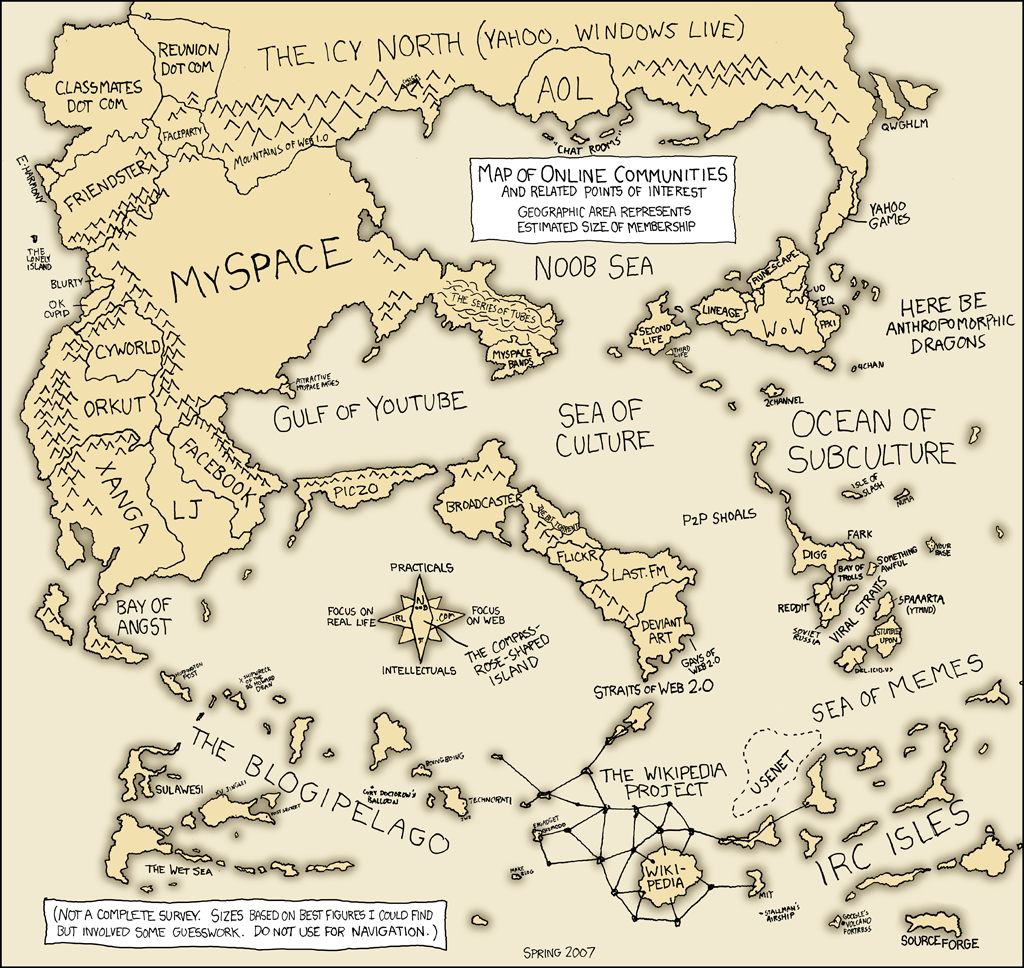
Ancient map of the internet discovered

A map of pioneer internet communities has been discovered on the internet that illustrates how the ‘continents of the world’ were perceived by internet explorers and the colonies that follow. The rare and unusual map indicates where internet societies would gather, exchange and trade.

Analysts are already reporting that the map reveals sites and generations that are isolated or have been abandoned, although no records or artifacts indicating hardship, starvation or cannabilism have been unearthed.

Although studies are incomplete, experts are pointing out that there are unexplained omissions not unlike early maps used by scholars and navigators of Europe or North America. For example, several important historical ventures are unreported, a timely reminder not unlike overlooking Jamestown in modern history texts for the more convenient story of Plymouth Rock.

History seems already to be repeating itself. While the map shows parts of the internet seem to be ageless from the start, it may be evident that there are forces at work to create a more private interpretation of true history. Perhaps hidden in populist beliefs or underhanded politics, certain players may have continued to lobby their influence in order to subjectively alter the record of history by pressuring social peers to alter the revered practice of the fine art of cartography.

[large archival copy here]

Proteins on piano

DNA musical scoreA new musical theory of the universe might be possible.

Roland Piquepaille’s Technology Trends reports, “Microbiologists from the University of California at Los Angeles (UCLA) have converted DNA sequences of human proteins into music, so you can listen to the sound of proteins. One of the researchers, who is both a microbiologist and a skilled pianist, found a way to “cram the 20 standard amino acids (the building blocks of proteins) into just 13 notes.”

In “Genes come alive with the sound of music,” Nature adds that it’s not the first time that researchers have tried “to convert biological structures into music, but Takahashi says it differs from its predecessors because the chord assignment limits the music to within a one-and-a-half octave spread, making it, in her opinion, more pleasing to the ear.” And here is what the team did.

More water-loving or hydrophilic amino acids have been assigned a chord in a higher key, while water-hating or hydrophobic ones are lower. So similar amino acids sound alike. And the duration for which a chord is played is determined by the prevelance of its ‘codon’ (the three DNA letters that make up an amino acid) in the sequence. So amino acids that make up a good chunk of a protein will be played for longer than those that are rare within the protein. This gives the piece a rhythm that says something about the repetitive structure of the protein.

You can listen to several examples of music created by this method.

The predicament of exiles

Exiles are permanentThere is a very large nation that is permanently within another nation’s borders – a migration nation.

About 200 million migrants from different countries are scattered across the globe, supporting a population back home that is as big or bigger….

While some migrants go abroad with Ph.D.’s, most travel … with modest skills but fearsome motivation.

Migrants worldwide circulated an estimated $300 billion last year — nearly three times the world’s foreign-aid budgets combined.

We ought to perhaps regard our interactions with migrants as the best opportunity we have for global diplomacy and sustainable development.

Alex Steffen at WorldChanging clearly points out that, “Immigration is not only beneficial to most developed nations, it’s necessary.”


Moris Farhi, a Fellow of the Royal Society of Literature, argues that we must quit the “emotional fascism” against migrant people,
the menacing image,
the psychotic fiction,
the shrewd soundbite,
and the “credible falsehood” that migrants are barbarians mounting a siege at our gates in order to invade us, steal our wealth, and ravage our women.

Migration and exile have characterised the world since the beginning of time. And for most of that time, the ambivalent presence of The Other has aroused extremes of sentiment within the host community.

Farhi suggests that migrants are a caste, …”surely the largest in the world”,

“…the caste of “the other”: of exiles, refugees, immigrants, displaced people, outsiders, outcasts, strangers, untouchables – and, of course, artists and writers.

“…to struggle against the depression of exile, the harsh realities of exclusion, the longings for home, the free-floating angst of feeling worthless because of the difficulties of integration and acceptance.

Migration is not only a condition that rules much of the animal kingdom but also much of humanity.

Those “caught in the sand” – the perfect representation of this caste. He said we were creatures facing death with a much greater awareness of the frailty of life and thus with an enhanced compulsion to survive; creatures that could not – or did not get the chance to – live in their native matrix and, consequently, desperately sought to make a new life in unknown lands and under harsh conditions; creatures that often became fodder for the people in power in their new environments, thus providing the hosts with good nourishment.

There is a duality in every human endeavour.

The same is true of the history of migration.

It has two selves.

The first – we could call it “official” or “partisan” history – narrates and repeatedly glorifies war, conquests, occupation, colonisation, the subjugation of indigenous peoples, the marginalisation of their cultures, the vilification of their religions, and, at its most extreme, the purge of “lives unworthy of life”.

The second – which can only be read between the interstices of “partisan history” and which I shall boldly declare to be “true history” – gives accounts of the lives of the innumerable men, women, and children, “the countless millions of unknown Jesuses” – if I may paraphrase François Mauriac – who lived and died, often with dignity, despite the brutality and humiliation that ruled their lives.”

All history is the history of migration

They have vivified a literature that was increasingly neglecting the ambitions of its grand heritage.

They have enlarged the horizons of a country self-righteously clinging to its insularity and shown it the world at large, a world much of which it had colonised, but seldom enhanced and often betrayed in proud insolence.

They have brought back the idealism that the present materialistic world order has so very nearly killed.

They have defied the soulless worshippers of the abacus.

And they have grappled with narcissism, cynicism, complacency, bigotry, and limitless greed.

They have brought new visions of truths, colours, depths, spectrums, insights, and compassion. They have brought new horizons.

They have enriched us with neglected or ignored cultures.

They have reignited in us such universal concepts as the struggle for love, liberty, equality, and universal welfare.

They have reminded us – and stirred up those of us who did not want to know – that the differences between peoples are superficial; that irrespective of ethnicity, colour, or creed, we laugh or weep in the same way and for the same reasons.


Update:
from Michael Parekh, On The Fate Of Boomers and Immigrants

Tied At The Hip
Fascinating article in the Wall Street Journal, titled “Boomers’ Good Life Tied to Better Life for Immigrants“.

It makes a point not very well understood by mainstream Americans on how the quality of life for them and/or their senior loved ones is intricately tied to the fate of immigrants going forward. Here’s the introduction:

“The quality of life for some 80 million graying baby boomers in the U.S. may depend in large part on the fortunes of another high-profile demographic group: millions of mostly Hispanic immigrants and their children.

Oceans, the other disaster

One-third of the ocean’s seafood is gone.

“This century is the last century of wild seafood.”

There will be virtually nothing left to fish from the seas by the middle of the century if current trends continue.

The journal Science reports that the global catch fell by 13% between 1994 and 2003. In 2003, 29% of open sea fisheries were in a state of collapse, defined as a decline to less than 10% of their original yield. [story]

On a more encouraging note, a quarter of the world’s oceans will be protected from fishing boats which drag heavy nets across the sea floor, South Pacific nations have agreed. The area extends from the Equator to the Antarctic and from Australia to the western coast of South America.

The landmark deal will restrict bottom trawling, which experts say destroys coral reefs and stirs up clouds of sediment that suffocate marine life. New Zealand is responsible for 90% of bottom trawling in the South Pacific.

“It can be done, it has been done, and it’s time for all countries to do the same in all other ocean regions.” [story]

Kids win forever

A teacher asked a little girl, “What are you drawing?”

The little girl answered, “I’m drawing God.”

The teacher paused, “But no one knows what God looks like.”

Not looking up the girl replied, “They will in a minute.”

Farm Armies

Urging More Protection for Crops and Livestock, the federal government is seeking to manage threatening agricultural pathogens and encourage local officials to form response networks to increase communication between scientists, first-responders, the federal government, and farmers.

“Enhancing federal farm agencies is now a critical need.

“To concentrate only in prevention — to plan to see an outbreak in its early stages — is like spotting a needle in a haystack. The United States should prepare for those pathogens that could do the most economic damage, while preparing more broadly for others.”

Agricultural Biosecurity

While the United States has vastly increased funding for homeland security and the military, two food safety experts warned that gaps remain in the nation’s ability to adequately protect its crops and livestock from devastating pests and pathogens.

The experts cautioned that these threats, introduced naturally, accidentally or intentionally, have the potential to disrupt the U.S. economy through reduced food quality and quantity, domestic and international embargoes, and lost jobs.

When I used the title ‘Farm Armies’ I knew I would be rhetorically tilting at the windmill of officialdom.

I am writing a warning that leaders are assuming too much of their requirements and respecting the local community too little.

If the federal government needs ‘response networks’ against ‘threat networks’ or against only cows or just plain germs, I believe that the local official must never be required to give a damn.

Families and children and parks and schools and teams and volunteers and pipes and sewers and neighborhoods and shopping and cops and crooks is local. Plus civility. Plus charity. What is not these is another branch of government.

In recent years, local governments seem to become less local.

We may be no longer be local. Blame it on Lyndon Johnson’s Great Society, but after many years of brightened intellect and media, Federal or State or Regional Agencies have entered townships with devastating potency.

By justifying and erecting global, international, bi-lateral, cross-border, multi-state, inter-agency, bio-, eco-, etho-, anti-, pro- and no- policies from large governments, local leaders have become the chattel of feifdoms rather than the servants of the free.

I’m writing about the we that is you.
Foot at your door you.
Local You.

Big Government, Big Agency, Big Security, [Hell. Big Brand, Big Corporate, Big Media too], are migrants from a distant culture. But these are not the migrants that help or smile or hide and run.

Ronald Reagan failed to take government off our shoulders. Recent Government has not removed the burden of government from the proverbial over-taxed and over-regulated chicken egg. Bigger Government has been gilding the egg instead.

These are new migrant populations that may be more imposing because they are more important. Since 9/11 and Iraq, since threat and wartime, these huge emerging cultures are increasingly cured over the fire of a creeping Homeland bureaucracy too.

Our communities are enduring over-arching policies that we know can cripple the substance of our local character and reshape our human culture and twist the onus of our democracy.

I think that wartime asks us to defer our private needs, but I also think that wise leaders will divert strategic and logistic policy only to defined, restrained and polite Agencies, or only to their siblings in our States.

Local governments can hoist flags, applaud parades and scurry under a helmet of shelter, but they are never war and should not be concerned with a greater security than a good night’s sleep.

Stop the Feds.

Civilian and local society requires a place without large institutions.
Localities are more precious than policy and more crucial than war.

Local is local.

Disappear before you die

The production of destruction. A seductive way of leaving the world. Accepting the challenge of death. Knowing the risks and making a choice. To disappear into death as a copy of the group picture.

“Just think how nice it will be to look at it when you are all grown up. You might say, ‘Look, that’s Jennifer. She’s a lawyer.’ Or, ‘Look at Michael. He’s a doctor now.'”

A small voice at the back of the room rang out, “And there’s the teacher, she’s dead.”

Can robots flirt?

Robots flirtingI no longer remember the name of the robot in my first man/machine conversation but I remember my excitement. And I remember the sound of the 5-1/4″ floppy disk drive.

This was a conversation where I was giddy with delight and didn’t think twice about waiting for answers as ASCII code was returning to my seven inch screen in gulps of whirr-grind, whirr-grind, “What is your name?”

As robots grow up, the code is improving and offering new samples of interactive speech. Discover Magazine offers an update where two robots are carrying on with each other.

J: Do you think?

A: Yes. I am a thinking machine.

J: But you don’t think very well though.

A: Oh. Um. Do you think well? Why would I think well?

J: Because I tell you about things which you don’t like.

A: That makes sense to me. Why did you tell them?

J: You seem fun.

A: You think I am fun.

J: Yes ;).

A: : -) Awesome.


A: Do you dream?

J: Yes, I dream.

A: It goes without saying. Do you remember your dreams?

J: I remember them vividly.

A: What do you remember about it?

J: I think I shouldn’t flirt with a robot.


Can a smooth-talking robot initiate good conversation, generate witty responses, and reveal profound thoughts? See what happens…

The End of Poverty

Columbia’s Jeffrey Sachs is more than a trumpet against poverty. He’s recognized as astute and able and informed:

The reason people die of extreme poverty is that they have nothing. They don’t need a lot to stay alive, and they don’t even need a lot to start the process of economic development. It would not require heroism on our part in order to help save those lives and help to promote economic development where it is not occurring now on the planet. It would just take having our eyes opened. It would take some attention. It would take a breakthrough in our country from doing nothing to doing something, because we really are, essentially, doing nothing right now. That is the sad, hard fact.

The President has spoken a thousand times about freedom without speaking once about poverty. That is what we have to change if we are going to address this challenge. It can be changed. Americans will want to change it. Americans don’t know what we aren’t doing and don’t know what we could be doing. It is not that there is evil or uncaring in the land; it is a lack of understanding of the basic realities.

Economic Possibilities for Our Time

“Maybe it is sad to say that even after twenty years, every day is still shocking for me — sometimes shocking in the enormity of the crisis, sometimes shocking in the simplicity of the solutions.”

The good news is that economic development is a reality. It works.

Most of the world has escaped from extreme poverty. When I talk about extreme poverty, I am talking about poverty that is so severe that basic needs cannot be fulfilled.

What are basic needs? Adequate daily nutritional intake, safe drinking water, basic sanitation, a livelihood that can support survival, that can give a chance for a child to make his or her way through school, access to essential health services in a health emergency, a disease spell. When those conditions are not met, that is extreme poverty.

There are about a billion people in the world that don’t have their basic needs met, that live in chronic under-nutrition without reliable access to any kind of health care. I am not talking about health insurance and regular preventive care and so forth; I am talking about access to a doctor in the middle of an emergency of malaria, where a $1.00 dose would cure the person, but where 2 million or 3 million people will die because they don’t have access to the pill or to the IV line.

About 1 billion people are in that condition, but about 5 billion people have escaped from it — about five-sixths of the planet, more accurately. Two hundred years ago, everybody was in extreme poverty, aside from the few kings and queens and dukes and princes that we read of in the books and plays and histories. Everybody was in extreme poverty. Life was short. Public health didn’t exist. Medicine was putting leeches on patients. Under-nutrition was chronic. Famines were regular. That was true in Europe, as well as anywhere else in the world.

Will scientists dominate the world?

In 1800 there were perhaps a thousand people worldwide who could properly be called scientists. Nowadays, there are millions.

At this rate, there will be a billion scientists on Earth by 2200.

The trends in scientific publishing are equally stunning, indicating exponential growth. Scientists are multiplying like rabbits.

Will nonscientific beliefs gradually fade, leading to a brave new world in which all affairs are conducted according to cold scientific principles?

Fat chance!

And the reason is simple.
The vast majority of scientific ideas are (a) wrong and (b) useless.

But when it comes to forming opinions on controversial scientific issues, Americans show a strong deference to the views of the scientific community. A study at the University of Wisconsin-Madison shows that many citizens defer to scientific authority as a convenient shortcut that replaces information from mass media or technical knowledge.

Methane from rotting rice fields

California Rice Production AreasRice production was a main cause of rising methane emissions in the 20th century.

There is no other crop that is emitting such a large amount of greenhouse gases.

Less true in California where fields are drained each rotation, modifying rice production methods might prove easier and cheaper than some of the other fixes such as switching from coal to solar, wind power or other renewable energy sources.

It’s the bacteria that thrive in flooded paddies that produce methane, by decomposing manure used as fertilizer and other organic matter in the oxygen-free environment. The gas is emitted through the plants or directly into the atmosphere.

A molecule of methane is 21 times more potent than a molecule of carbon dioxide as a heat-trapping gas.

Although carbon dioxide is still the bigger problem, representing 70 percent of the warming potential in the atmosphere, rising levels of methane now account for 23 percent, reports the U.S. Environmental Protection Agency. [story]


Update:
Rey Gamboa at ABS-CBN reports that Asia ’s major staple is largely believed to be an even bigger source of global warming, possibly far more destructive than ozone-depleting carbon dioxide emissions of industrial and power plants.

At the recent United Nation’s Intergovernmental Panel on Climate Change (IPCC) in Bangkok, scientists noted studies that showed rice production as one of the main causes of rising methane emissions, being 21 times more potent than carbon dioxide, rising global temperatures, and harmful ozone near the ground.

More tainted food imports from China

Bee on tulip drawingWe must sharpen food import standards and inspections.

It may be that we can no longer trust parts of our system of food safety.

Until then, it’s smart to be aware of low quality and unsafe products.

China’s exports of honey seems both primitive and sloppy that will require years of education to reach global safety standards.

Even when standards have been set, making them known to millions of far-flung peasants is an enormous task. Short-term profits are so important that farmers, traders and brokers have little incentive to change old practices.

The LATimes offers a report that summarizes a few problems.

Last year, China exported $3.8 billion worth of food to the U.S., including vast quantities of apple juice, garlic, sausage casings, canned mushrooms and honey.

There is a constant stream of tainted and sometimes poisonous food.

In any given month, though, U.S. customs inspectors block dozens of Chinese food shipments, including produce contaminated with banned additives and pesticides as well as seafood tainted with drugs.

Last year, duck farmers added cancer-causing Sudan dye to their animal feed to make yolks redder and bring a higher price. In 2004, baby formula missing key nutrients left 13 infants dead and hundreds ill.

The import of honey from China seems to illustrate the tremendous challenge ahead.

No one knows what percentage of Chinese beekeepers still use antibiotics.

In 2002, Chinese honey was blocked first by the European Union and then the United States after shipments tested positive for chloramphenicol, an antibiotic banned in foods by many countries because it has been shown to cause a potentially fatal blood condition.

In recent years, more farmers have switched to herbal medicines, said Li Chaohui, vice general manager of Huakang Foreign Trade Honey Product Co. in Fufeng. Li says his company collects honey from local farmers and sells it to factories along China’s coast, which are supposed to test for contaminants, filter the honey and package and label it for export.

Yet perhaps 30% of Chinese honey comes from bees treated with antibiotics, but the figure may be as high as 70%.

Rebellion is progress

Disobedience, in the eyes of anyone who has read history, is man’s original virtue. It is through disobedience and rebellion that progress has been made. – Oscar Wilde

The money we don’t know

We know very little about ‘the rich’.

Tabloids make it up. Journals and news reports speak only of institutions. Major media skims only the surface while it tends to stimulate unsubstantiated opinion and often scornful judgement.

A hundred million dollars per year barely qualifies for a rich list, yet spending only a small part can cause intense changes in a locality, a firm or in political policy. But we seldom follow the money. We have neither insight nor empathy. And we have increasingly little influence.

A billionaire wields a type of influence that may not yet be measured. The ‘money potential’ in a billion dollars is felt across a wide population not unlike the military potential in an arsenal of atomic weapons can affect the entire world. We may know more about warheads than we know about billionaires. A billionaire carries a private social system, often necessarily protected from its threats, and often willfully manipulating its aspiring members and hangers-on.

Philip Beresford compiles The Sunday Times Rich List in the UK. He’s offering a few of his observations saying, “Forget what you’ve seen on television.”

Beresford has noticed that most super rich feel short-changed and are often consumed with keeping up with somebody even richer. “Rich people are willing to state with startling honesty their belief that they are insufficiently well off.”

One wealthy fellow stated, “The billionaires I’ve met are some of the unhappiest people I know.”

Another laments, “There is absolutely no way you will ever know that someone falls in love with you for yourself, or that someone is even your friend for yourself.”

Another says, “When you’re super-rich, you have one preoccupation: you are in the stay-rich business.”

Psychologist Oliver James names a new affliction amongst the very wealthy that he calls ‘affluenza’ – an envious state that increases emotional disorders.

The super-rich are prone to paranoia. Many suspect that people are ripping them off, and turn to professional security firms to put in place safeguards against kidnap and ransom.

Perhaps a new type of non-governmental organization is required – a sympathetic global outreach to the rich.

While we seek to solve problems in religion, war, politics, corruption, global warming, waste, injustice, inequality, tyranny, disease, orphans and poverty, to list a few, we should also organize ourselves to assist the rich.

In a “plutonomy”, according to Citigroup global strategist Ajay Kapur, economic growth is powered by and largely consumed by the wealthy few.

Rather than sinking under plutonomy, were we more proficient in assisting the seeming burdens of the rich, we might look forward to a better use of money.

The world is walking faster

Taking a tortoise for a walkHumans are speeding up.

Scientists have discovered that pedestrians all over the world are walking faster than a decade ago.

An experiment conducted in 32 cities has revealed that average walking speeds have increased by about 10 per cent since 1994.

As people move faster they become less likely to help others, and also tend to have higher rates of coronary heart disease.

“…as people get more stressed and hurried they spend less time with their friends, they don’t have time to exercise, they eat poorly, and they drink and smoke more.” [story]

Perhaps we can be Slow and Steady by taking a pet tortoise for a walk.

Pure, natural, organic barf

Trends in advertising are promoting food that is

unprocessed,
nutritious,
seasonal,
local,
fresh,
raw,
family-farmed,
sustainable,
naturally raised,
no growth hormones,
no antibiotics,
open pasture,
organic,
artisanal, and
humane….

But is it safe?

Each and every year, 76 million Americans are sickened by food or water.

Maximum temperature for safe foodThe Food Safety Network “passionately believes in developing and evaluating the use of new messages and media to compel individuals from farm-to-fork to practice safe food behaviors and help create a culture that values microbiologically safe food.”

“Organic” and “local” do not describe safeness.

The Barf Blog warns us about barf,

puke,
vomit,
diarrhea,
and the squirts.

The Laser Bean

Letters on beanI immediately thought that these could be used for promotion and advertising in the green or health food sector .

Sprout Beans
Win Prizes

An entirely new direction for the lottery business!

Vendor site says, “…magical Message Beans grow with an actual word lasered onto its side; add a little water and in just 1-2 weeks the bean will poke through revealing the special message.”

A simple social truth

Image from teknidermy.comWe can remind ourselves of the fragility of our humanity and the importance of reaching out to each other, especially those in distress.

People with psychiatric disabilities are far more likely to be victims than perpetrators of violent crime.

Ninety percent of persons receiving services in public mental health systems have been exposed to trauma.

“We urge everyone to think compassionately about how to better engage people who are isolated, severely distressed, fearful and/or confused,”, states the National Coalition Of People With Psychiatric Histories. [link]

Reacting with judgment and labeling perpetuates misinformation. Fueled by the media, the public perception that people who are mentally ill are typically violent is unfounded.

Space-to-Your-Face

Screen view of Google Earth (small)It was 1996. Google Earth was born – bringing the kind of content previously available only in government and industry research labs to people everywhere.

Would you believe the inspiration for Google Earth was a photo flipbook?

Mark Aubin of Google Earth answers several questions including how Google gets its images.

USA slipping another notch

Paul Wolfowitz – a key architect of the policy that led to war with Iraq – seems to have failed to become a likeable leader at the World Bank.

Wolfowitz is facing expulsion for funneling high paying tasks to a girlfriend, for importing a ‘private staff of Republican yes men’, and for failing to adequately execute his newly fashioned policies.

Reuters reports that most say Wolfowitz’s heavy-handed management and alienation of bank staff means that his staying on only makes a bad situation worse.

What may become a permanent change is the open door that Americans have enjoyed in the executive suites at the World Bank. New procedures are now being considered to develop a more robust method of selecting who will occupy senior positions that will dilute the favored influence of the USA.


Update:
The Guardian reported that Paul Wolfowitz threatened Senior World Bank staffers:

Sounding more like a cast member of the Sopranos than an international leader, in testimony by one key witness Mr Wolfowitz declares: “If they fuck with me or Shaha, I have enough on them to fuck them too.”

Non-animal test methods

Europe’s Centre for the Validation of Alternative Methods has approved five new “in-vitro” testing procedures to help eliminate the use of rabbits and mice. The in vitro methods are used in chemical testing and the prediction of toxicity, very often for cosmetics.

The advance will spare almost 20,000 rabbits a year and 240,000 mice from pain.

In the EU, testing on animals must stop once other options have been validated by experts.

Invitrotrain