the worst decade

…the reactionary Bush era was just the worst of times.

I declare it the decade of the American oligarchs.

Juan Cole:

We have always had robber barons in American politics, but the Neoliberal moment created a new social class. At about 1.3 million adults, it is not too large to have some cohesive interests, and its corporations, lobbyists, and other institutions allow it to intervene systematically in politics.

It owns 45 percent of the privately held wealth and is heading toward 50….

our vibrating blood

human red blood cell. Park et alMuch like a tightly wound drum, red blood cells are in perpetual vibration.

Vibrations help the cells maintain their flattened oval or disc shape, which is critical to their ability to deform as they traverse blood vessels in the body to deliver oxygen to tissues.

Understanding the vibrations could help develop treatments for malaria, sickle cell anemia and spherocytosis.

The vibrations are nearly impossible to study because their amplitude is so tiny (nanometer, or billionth of a meter, scale), and they occur in just milliseconds.

more becomes known

Cheney & Bush:

Between 2002 and 2008, the amount spent on government contracts more than doubled. The amount spent on no-bid, non-competitive contracts jumped by 129 percent. [link]

rulings to live by

Google announces here that Google Scholar has added full text legal opinions from U.S. federal and state district, appellate and supreme courts.

For average citizens, however, it can be difficult to find or even read these landmark opinions. We think that’s a problem: Laws that you don’t know about, you can’t follow — or make effective arguments to change.

phoney phructose phfail

New Scientist:

Sugar-free sweeteners might fool your taste buds, but your brain knows better.

Sugar-free sweeteners activate brain areas that register pleasant taste, but not strongly enough to cause satiation. “That might drive you to eat something sweet or something calorific later on.”

Even as manufacturers get better at blending these agents to avoid peculiar tastes, their ability to help us cut down on calories and keep our weight in check is coming into question. A handful of studies, starting in the 1980s, suggested that regular use of artificial sweeteners might even make people eat more, rather than less, by stimulating their appetites without satisfying them.

skyrocketing feed costs

Cropland used for pasture or grazing declined by 41 percent from 2002 to 2007.

Ethanol production more than doubled feed costs for livestock producers in the United States. By 2008 more than one third of corn in the U.S. was diverted to ethanol production. [Futures and Commodity Market News]

Another Mission Accomplished.

a game of mere winning

William Voegeli:

What sets the politicians of 2009 apart from the ones of 1787 is the pervasive modern denial that human nature is something we can understand and a basis on which we can found a political order.

The Americans who wrote and ratified the Constitution believed in certain truths about human nature. These included our fundamental equality, the securing of our inalienable rights as the government’s raison d’être, and the need to channel the natural selfishness that engenders factionalism through a constitutional mechanism that protects individual rights and promotes the public good.

The modern belief, instead, is that what matters is human history, not human nature, our evolution rather than our essence.

a game of mere myth

Frans de Waal:

Market fundamentalists model human society on the perpetual struggle that they believe exists in nature. But this “struggle” is merely the projection of their own ideological prejudices…

her cruel cruel backer

Christopher Hitchens:

It beats me why such a disgusting character is still received in polite circles, except that now at least he’s back doing the sort of task to which he is best-suited. He has found an unscrupulous and uncultured political neophyte who will happily act as a megaphone…

Sarah Palin backed by Fred MalekThe person who has been introducing Palin into the more exalted social and political circles of the capital, and who has already arranged her appearance at the Alfalfa Club, is Fred Malek.

Two things about Malek are worth bearing in mind.

One: The first is that he was an important member of the Nixon administration, a senior figure on the Republican National Committee, and the campaign manager for the re-election of George H.W. Bush in 1992. With his Carlyle Group and other corporate connections and his mansion in suburban McLean, Va., Malek is almost the prototypical ‘establishment’ Washington insider and consiglieri Republican, against whom Palin’s adoring book-tour crowds, in their pathetic dreams, imagine her to be a crusader.

Two: Because the second thing to note about Malek is that he was the man who drew up a list of Jews to be fired from the civil service under the Nixon administration.

the climate debate

Tony Blair’s summary on Copenhagen:

This is a tough time to be a decision-maker.

We live in an era of low predictability. The world appears in constant flux. The challenges are immense. And most of all, there is, in many instances a clash between the correct short-term politics and the correct long-term policy.

…. in respect of the environment and energy, whatever the financial pressures, if we think that the earth’s climate is probably changing as a result of human activity, we need to set the global economy on a low carbon path to the future.

This doesn’t mean that we can come out with unrealistic propositions as we struggle for a new global treaty to succeed the Kyoto Protocol.

We should not make the best the enemy of the good.

There are major things we can do on the basis of existing knowledge – on deforestation, energy efficiency and renewables – to make a big difference over the next decade. We will then require a long-term framework of incentives to develop the technologies of the future. But the point is: now is not the time to put off action.

The seriousness of China on this issue, and now India, the enthusiasm of Brazil and others in the emerging markets to participate in tackling climate change: all of this offers a huge opportunity that should be grasped.

And for the West, we should all remind ourselves about $100 a barrel oil. There are exemplary reasons of energy security why we need to change the nature of our economies to drive down carbon dependence.

Susan Kraemer’s summary on Copenhagen:

Copenhagen… moved the process forward.

All nations agreed to cooperate in achieving the peaking of global and national emissions as soon as possible.

The good news is that this time, unlike Kyoto, every nation is included. For the first time, China, India and the US were participants in a worldwide agreement that deep cuts in global emissions are required to hold the increase in average global temperatures to less than 2 C above the pre-Industrial Revolution level.

Developed countries commit to quantified economy-wide emissions targets for 2020, creating a joint $100 billion a year by 2020 to address the needs of developing countries, $30 billion from 2010 to 2012 to help developing countries mitigate climate change and protect forests… and to communicate impacts every two years….

The bad news is that this is not enough to save Tuvalu. Like the Maldives, they will be the first of us to go.

But it’s to be expected that there are losses.

As the decades roll by and we don’t switch to clean renewable energy fast enough, it will get harder and harder to come out of these international agreements to do something about the problem, because less and less will be achievable.

Jeff McMahon’s summary on Copenhagen:

And the Oscar goes to…

You will hear many denounce the Copenhagen Accord. Many would have done so no matter what happened here. There are many who dreamed of greater strides, and those dreams have again been deferred.

But isn’t it truly a dream to expect 193 nations–each with its own demands–to draft a detailed agreement together?

Nearly all of the world’s nations have committed to greenhouse-gas emissions cuts, to a new fund that will channel hundreds of billions of dollars into green initiatives, and to some international oversight of their actions.

In the most immediate and practical terms, over the next three years $30 billion will go to the poorest nations of the world, where it can stretch the farthest, to help those nations develop clean energy sources.

Agreements have been struck on deforestation, reforestation and clean-technology transfer. Brazil, where the Amazon jungle has been shrinking for centuries, has committed to redesigning its agricultural system.

Numerous nations have struck side deals, committing more hundreds of billions to green goals.

In loftier terms, the state of our planet is now undeniably the world’s leading political issue.

throw that life away

Warren Richey:

The US Supreme Court ruled in 2005 that it is cruel and unusual punishment to sentence a juvenile offender to death. On Monday, the high court takes up two cases that seek to extend that same constitutional reasoning to the practice of sentencing juveniles to life in prison without any possibility of parole.

The essence of their argument is that adolescents who commit crimes are still developing as human beings and their characters are still largely unformed. It is wrong to write them off as hopeless, to lock them up and throw away the key, these advocates say.

Brian K. Mahoney:

On November 8, the Supreme Court heard appeals for two juvenile offenders serving life-in-prison terms in Florida. Neither involved homicide. Joe Sullivan burglarized and raped a 72-year-old woman when he was 13. Terrance Graham committed armed burglary at 16. Both were repeat offenders.

Lawyers for the youthful offenders argued that life in prison for juveniles not convicted of homicide violates the Eighth Amendment’s ban on cruel and unusual punishment.

There are 109 juvenile offenders serving life without parole for nonhomicide crimes. All are in the US, 77 are in Florida.

Nineteen states, led by Louisiana, have filed a brief supporting life sentences without parole in nonhomicide cases citing that teenagers have a clear appreciation of right and wrong.

The court is divided on the matter, as expressed by comments by Justice Stephen Breyer during the oral arguments:

“As a general matter, human beings are uncertain about how much moral responsibility to assign to individuals in a particular category. Is it appropriate to sentence someone to life in prison without parole at the age of 10? No. Eleven? No. Seventeen? Yeah, maybe. We are in an area of ambiguity, what justifies taking a person’s whole life away.”

loose and sociopathic

Aaron Swartz:

Googling for Sociopaths

They’re just interested in conquering more and taking control.

So naturally the sociopaths are outraged that their control is being taken away.

One of the best things about capitalism is the way it handles sociopaths. Major executives look up to Alexander the Great and apparently try to follow in his footsteps. But instead of leading a murderous campaign across Asia, they decide to make something people want: newspapers and movies and television shows. True, they’re far from perfect, but you have to admit it’s a lot better than mass slaughter.

longest solo sea voyage

Reid Stowe:

This voyage became the longest nonstop sea voyage in history when I passed …658 days… and now that I have sailed 658 days alone, this is the longest solo sea voyage in history!

reign on me

Mort Lippmann:

They observed that both concentrations of airborne nickel and daily deaths from heart disease were much higher in New York City than any other city in the United States.

Around the world, fine particles – smaller than a few microns in diameter – have been linked to increased hospitalizations and deaths from cardiovascular and respiratory diseases within hours to days of exposure.

Can’t keep it out of our bodies, pull the permit.

myth pushed on public

Henry CK Liu, AsiaTimes:

In recent decades, an intuitive myth has been pushed on the unsuspecting public by supply-side economists – that low taxes encourage corporations, employers and entrepreneurs to create high-paying jobs.

The counterintuitive historical truth is that a progressive income tax regime with over 90% for top-bracket incomes actually encourages management and employers to raise wages.

Read that twice.

they sell what?

Six Quebec institutions including the Université de Montréal, Concordia University, Université Laval, McGill University and l’INRS-Institut Armand Frappier with specialists in pediatrics, endocrinology, cardiology, genetics, nutrition, biochemistry, vascular imaging, health psychology, social sciences, kinesiology, dentistry, epidemiology, biostatistics and public health, discover that childhood obesity is directly related to how close kids live to convenience stores.

crop corruption

Trail of Afghanistan’s drug money exposed:

A new report by the United Nations gives the impression that the Taliban are the main culprits behind Afghanistan’s drug production.

In fact, only 10-15% of Taliban funding is drawn from revenue generated by opiates.

Over 70% of drug money is captured by government officials, the police, local and regional powerbrokers and traffickers….

blame inherited debt

XXXXXXXXXXSome critics charge that President Obama and the 111th Congress generated the huge federal budget deficits that the nation now faces.

In fact, the tax cuts enacted under President George W. Bush, the wars in Afghanistan and Iraq, and the economic downturn together explain virtually the entire deficit over the next ten years.

Economist Mark Thoma says, “Notice the tiny contribution of Tarp, Fannie, and Freddie (red) and the stimulus package (just below the red) to the deficit from 2012 onward. These are not our long-term budget problems.”

Please note the 2019 Deficit without George Bush.

Jay Rosen: “President George W. Bush was a radical, not a conservative or traditional Republican. The press never took it seriously; in my view, that was a bad decision— if we can call it that.”

the talent myth

“There are three types of bankers: those that can count, and those that can’t.” – Eddie George

Martin Taylor, former Barclays CEO:

Yet two years later the whole industry was bankrupt.

A simple reason underlies this: any industry that pays out in cash colossal accounting profits that are largely imaginary will go bust quickly.

Not only has the industry – and by extension societies that depend on it – been spending money that is no longer there, it has been giving away money that it only imagined it had in the first place.

Worse, it seems to want to do it all again.

Paying out 50 per cent of revenues to staff had become the rule, even when the ‘revenues’ did not actually consist of money.

How did the shareholders let them get away with this? They were sitting on the gravy train too, enjoying the views from the observation car. How did the directors let it happen?

While many argue about regulatory overreach in a nation of chaos, Yves Smith at NakedCapitalism sees very much fraud, “We all need to start using the F word a lot more, because a great deal of what went on was criminal and needs to be described in those terms.”

economic amnesia

I wonder at times if our nation has entered a state of purgatory – all of us mulling around in the waiting room to Hell, anxiously counting the minutes until the grim reaper saunters through the door sickle in hand his mission to send us off to eternal damnation.

American Purgatory, by Greg Simmons and Brett Buchanan:

At our current rate of productive attrition we will soon be a nation of declawed housecats, possessing no skill-set whatsoever to survive in a world where the ability to produce real goods still reins supreme. Yet we remain the ‘entitled society’, when we are entitled to nothing.

Bad drives out good. This is a reality of which we should all be acutely aware but rather are immune to its possibility.

We dangerously believe we cannot fail. That, in fact, is the greatest gamble of all. A roll of the dice against history, a bet against all natural laws of the universe…

As we truly moan.

grabbed at the root

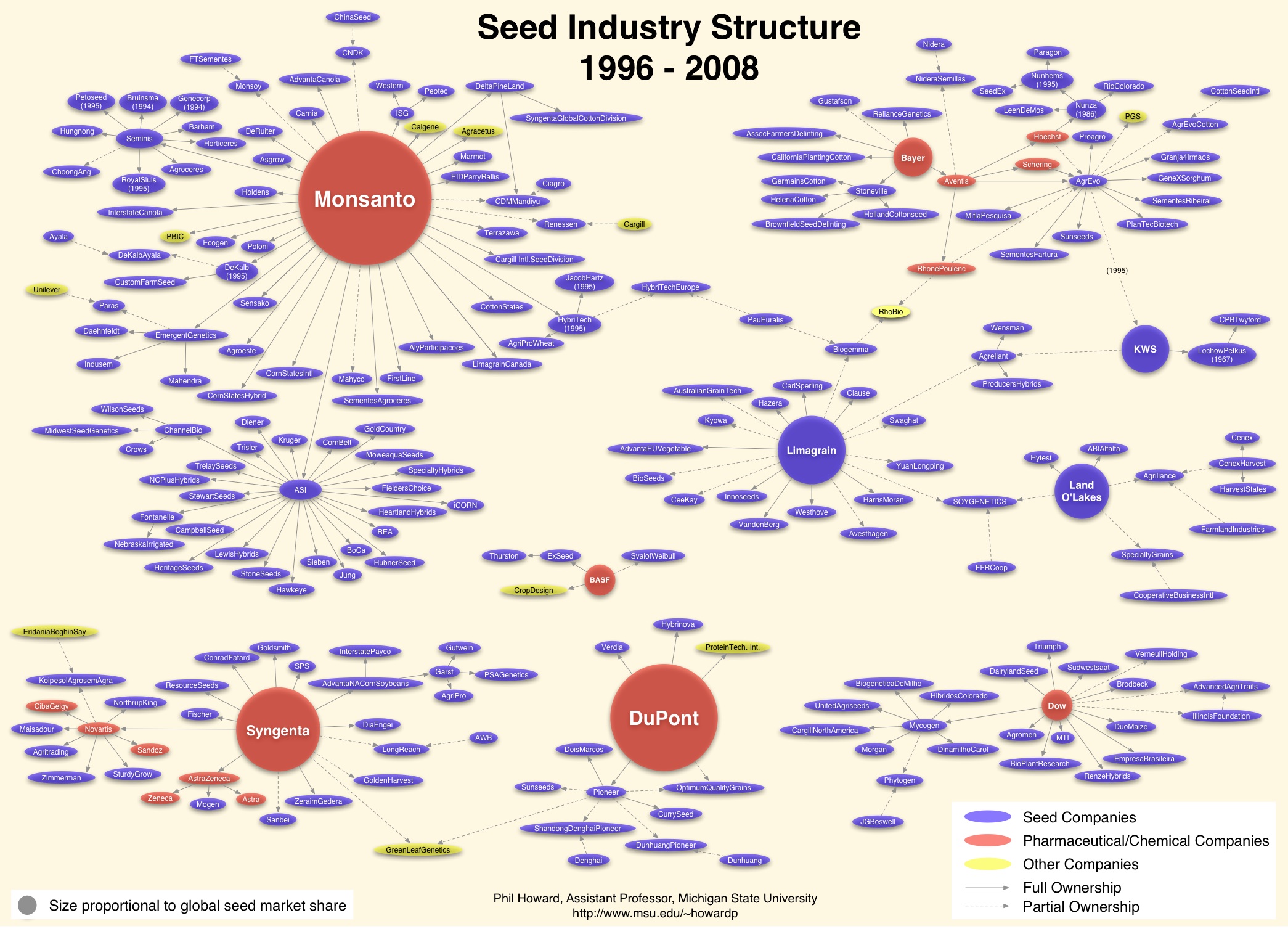
Seeds, another treasure stolen during our binge of unfettered markets.

Keywords: seed industry; consolidation; concentration; oligopoly
.

Abstract: The commercial seed industry has undergone tremendous consolidation in the last 40 years as transnational corporations entered this agricultural sector, and acquired or merged with competing firms. This trend is associated with impacts that constrain the opportunities for renewable agriculture, such as reductions in seed lines and a declining prevalence of seed saving. Since the commercialization of transgenic crops in the mid-1990s, the sale of seeds has become dominated globally by Monsanto, DuPont and Syngenta. In addition, the largest firms are increasingly networked through agreements to cross-license transgenic seed traits.

To better characterize the current structure of the industry, ownership changes from 1996 to 2008 are represented visually with information graphics, Consolidation in the Global Seed Industry, Philip H. Howard, Michigan State University. [Large Pic]

Seed Industry